

I heard the news today…* You’re Not Alone Premiers; news from Duncan and Lexi; Ava Cherry’s new show; Bowie’s Central Park Apartment for sale; Brixtone documentary, “It Ain’t Easy” cover plus MORE!
Welcome to my weekly roundup of Bowie news! This edition includes several reviews of the David Bowie: You’re Not Alone immersive experience. There were enough distinct perspectives to warrant a dedicated section, though a couple of more straightforward news pieces appear below. Read on for summaries of all the Bowie-related stories from the past week, and click on the story names to link to the original articles.
—
NEWS
Boy George leads the stars at the world premiere of David Bowie: You’re Not Alone. Boy George, Glen Matlock and Paul Cook of the Sex Pistols, Damian Lewis, Alison Mosshart, and others attended the London premiere of David Bowie: You’re Not Alone at King’s Cross. Related: All Saints’ Natalie Appleton’s son Ace Howlett towers over her as they attend immersive David Bowie event. Also, oddly, this one: Nxdia tells us how a ‘terrible break-up’ inspired new EP Lovemesick. And, this one: Sex Pistols’ Paul Cook: ‘I hate the music industry more and more the older I get’

Lexi shares Bowie sketch. Lexi Jones shared a personal sketch on social media this week that her father, David Bowie drew for her when she was 15 and in treatment, explaining that it was his response to an earlier drawing she had made to express feeling like she was “drowning within” herself. The post offers a glimpse into a private moment between father and daughter, reflecting both her struggle at the time and Bowie’s attempt to answer it through art. Note, this story does not link to a seperate article.
Duncan Jones new movie trailer. Bowie’s son Duncan Jones is developing Rogue Trooper, an animated adaptation of the 2000 AD comic using advanced visual technology and a notable cast, with limited plot details revealed and no confirmed release date.

Ava Cherry Set to Judge New Talent Show Project. Bowie collaborator and Chicago native Ava Cherry has said on social media that she will serve as a judge and talent coordinator on “Sound Star Chicago,” a planned talent competition she describes as being in the vein of “America’s Got Talent.” Details about the project, including its release platform and premiere date, have not yet been announced. Note, this story does not link to a seperate article.
Bowie’s NYC Apartment Is Listed For Nearly $5m. Bowie lived in this Essex House apartment on Central Park South from 1992, shortly after his marriage, until moving to SoHo in 2002.
Record Store Day 2026. Record Store Day’s 19th annual event drew early crowds for exclusive releases, including special collectible vinyl and cassettes from artists such as Bowie alongside Charli XCX, Muse, Suede, and The Cure.
Bowie connection to bizarre conspiracy theorist. This headline links to a New York Times story about a former capitol police officer whose life was turned upside down after being wrongfully implicated in the notorious Capitol Hill pipe-bomb case by a couple of conspiracy theorists, one of whom is named Steve Baker. According to the article, “Mr. Baker was a musician from North Carolina who had performed as David Bowie in a tribute act before focusing full-time on his personal blog.” This guy is giving Bowie-related bloggers a bad name!
—
YOU’RE NOT ALONE REVIEWS
As mentioned above, this following section contains links to critical reviews of You’re Not Alone. Even if my brief summaries make some of these appear to be very similar, the links each will take you to unique articles.

The Guardian. You’re Not Alone presents a sanitized account of Bowie’s career that omits much of his riskier or less commercial periods while framing his post-Let’s Dance struggles as resolved by Black Tie White Noise, though the exhibition’s sound design powerfully enhances his 90s work, making tracks like “I’m Afraid of Americans” and “Little Wonder” sound particularly strong.
Uncut. Given its density, You’re Not Alone overwhelms with immersive visuals and sound built around Bowie’s own reflections, using elaborate reconstructions and extended performances of songs like “Rebel Rebel,” “Space Oddity,” “Let’s Dance,” “Rock ’n’ Roll Suicide,” and “Heroes” to celebrate his artistry—despite omissions—while ultimately reinforcing that Bowie’s enduring appeal lies in his intelligence, self-awareness, and ability to synthesize influences.
Time Out Worldwide. You’re Not Alone struggles to balance Bowie’s vast, familiar legacy within its short runtime—at times relying on distracting animation and limited voiceover insight that can confuse newcomers—but at its best uses immersive visuals and sound to powerful effect, with performances of songs like “Rebel, Rebel,” “Starman,” “Blackout,” “Jump They Say,” “I’m Afraid of Americans,” and “Rock ’n’ Roll Suicide” capturing the scale and impact of Bowie’s artistry.
The Times. Amid an already saturated landscape of Bowie retrospectives, You’re Not Alone offers an immersive and imaginative—if not especially revelatory—experience that uses performances of songs like “Starman,” “Rebel Rebel,” and “Heroes” alongside Bowie’s own reflections to capture his enduring appeal, even as it underplays the contributions of key collaborators.
NME. You’re Not Alone is presented as a thematic, immersive experience built from extensive archival material and Bowie’s own words to trace his creative evolution and inner life, using reimagined footage and performances—including moments like “Stay”—to capture both the scale of his artistry and his human, self-aware perspective.
Immersive Rumours. You’re Not Alone demonstrates how effectively Bowie’s music and image translate into immersive projection, positioning the show as a compelling tribute that could influence similar experiences while reaffirming his lasting appeal to both devoted fans and casual listeners.
Gazeta Express. You’re Not Alone presents a selective, sanitized portrait of Bowie’s career while using immersive sound and visuals to powerfully elevate his music—particularly 90s material and moments like “Heroes”—and convey his reflections on art and fame, resulting in an emotionally engaging tribute despite its omissions.
Daily Star. You’re Not Alone incorporates rare footage from Bowie’s final concert—where he performed through a serious health episode later identified as a blocked artery—alongside immersive recreations and performances like “Heroes” to convey the full power of his live presence and career.
British Vogue. The show presents Bowie through thematic lenses like curiosity and outsider art rather than chronology, using sequences like evolving performances of “Rebel Rebel” to reveal the human continuity behind his reinvention and to underscore how he reshaped culture by turning his own imagined realities into something tangible.
KTEN. The show features about 40 Bowie tracks and concludes with his reflections on aging, embracing uncertainty, and accepting life and the universe as chaotic and untidy.
The Standard. The show powerfully conveys Bowie’s artistic commitment and outsider message, culminating in a climactic performance of “Rock ’n’ Roll Suicide” that delivers his assurance that those who feel different are not alone.
FAD. “You’re Not Alone” immerses me inside Bowie’s fragmented, theatrical imagination and captures his refusal to be defined, presenting him as a singular artist whose fluid identity and creativity make the show essential viewing.
NY Sun. This is a paywalled article, but I’m linking to it both because its written by Alexander Larman and it suggests that the show might come to New York.
The Strange Brew. The immersive Lightroom show presents Bowie as a god-like, endlessly reinventive figure through a sweeping cut-up-style digital collage that captures the awe of experiencing his arrival in real time and celebrates him as rock and roll spectacle.
—-
FEATURES AND REFLECTIONS
The Role of Producers in Shaping Artist Identity. Bowie’s defining qualities raise the question of how much credit belongs to collaborators like Tony Visconti and Brian Eno, highlighting that producers often play a central role in shaping an artist’s true identity rather than merely supporting their vision.
How Mott The Hoople fell to earth. I don’t think there is anything new in this lengthy article, but it does not seem formulaic, which is why I’m placing it here rather than the “churnalism” section. So, if you want to read a lot about Mott the Hoople, with guest appearances by Bowie, Mick Jagger and others, this one is for you.
The Netflix Film That Proves What’s Wrong With Modern Children’s Movies. Labyrinth, featuring Bowie as the Goblin King, remains a perfect children’s movie precisely because it confronts darker themes that modern Hollywood films avoid, even if it unsettles young viewers.

The Church of David Bowie. Bowie’s work and life reflect a restless search for spiritual meaning across Christianity, Buddhism, and other beliefs, with moments like his 1992 Wembley recitation of the “Our Father” suggesting but never resolving a deeper reckoning.
Remembering Prince on the 10th anniversary of his death. In 2016, marked by the deaths of Bowie, Prince, and other major cultural figures, the sense of loss felt especially acute, with Bowie’s passing shaping both personal listening and the broader experience of writing about music during a year defined by constant tributes.
—
PROFLIES
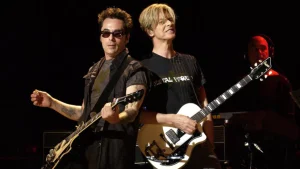
Earl Slick. Earl Slick, who later witnessed both Bowie’s major successes and the 2004 onstage heart attack that ended his touring career, first joined him in 1974 for the Diamond Dogs tour after being recommended by Michael Kamen and impressing in a standout audition following Bowie’s split from the Spiders From Mars.
John Cameron Mitchell. John Cameron Mitchell argues that no contemporary artist matches Bowie’s depth and commitment to fully realized personas, recalling Bowie’s personal support for Hedwig and the Angry Inch and emphasizing how Bowie’s unsettling, apocalyptic vision continues to resonate in a politically unstable moment.
David Mallett. This interview with Paris-based hair stylist David Mallett is really not about Bowie, but Mallett mentions Bowie a couple of times.
Violet Grohl. Violet Grohl’s early musical development included performing jazz in Los Angeles with Bowie’s pianist Mike Garson, drawing inspiration from Amy Winehouse, and later transitioning to alternative rock through work with producer Justin Raisen.

Iggy Pop. This is a reprint of a 2006 interview with Iggy.
Fanny. The Millington sisters built a pioneering all-female rock band that earned admiration from figures including Bowie, highlighting their boundary-breaking role in music despite limited chart success.
Angie Bowie. Angela Bowie said her marriage to David Bowie ended in 1980 after he failed to support her career as agreed, and described a lasting estrangement from both him and their son, later reflecting on his death as shocking despite their long separation.
Gary Kemp. This post is basically a link to a video of Kemp discussing the impact Bowie had on Spandau Ballet and the New Romantics movement in the 1980s.
Bobby Gillespie. At the London launch of “David Bowie: You’re Not Alone,” Primal Scream’s Bobby Gillespie discussed meeting Bowie and reflects on what he considers the coolest thing Bowie ever did.
—
LISTS
The five most mainstream selections from Kurt Cobain’s favourite albums list. Nirvana’s MTV Unplugged performance of “The Man Who Sold the World” reflected Kurt Cobain’s deep appreciation for the album, which had initially gone largely unnoticed despite Bowie’s slow rise to fame and later success with “Space Oddity” and Ziggy Stardust.
10 famous albums produced by Tony Visconti. Tony Visconti, born in New York in 1944, rose from session musician to influential producer whose work with Marc Bolan led to a decades-long collaboration with Bowie spanning from David Bowie (1969) to Blackstar in 2016.
Great Tracks featuring Aynsley Dunbar. Dunbar’s session work led him to join Bowie’s band by 1974, contributing to Pin Ups and Diamond Dogs, the latter featuring the hit “Rebel Rebel.”
15 pop song ‘oopsies.’ A mistaken phone call during the recording of “Life on Mars” inadvertently made it into the final track, capturing a ringing phone and background cursing that Bowie and the team only noticed after assembling the song.
The 25 Greatest albums of 1972. The Rise and Fall of Ziggy Stardust and the Spiders from Mars is Bowie’s breakthrough masterpiece, launching his career, shaping ’70s glam rock, and inspiring fearless self-expression worldwide despite not being his most original or groundbreaking album.
Who played the Freddie Mercury Tribute Concert in 1992? Bowie addressed the crowd by asking them to remember those affected by AIDS before kneeling to recite the “Our Father” as a direct and personal tribute.
13 Album Closers That Got It Perfectly Right. “Rock N Roll Suicide” closes The Rise and Fall of Ziggy Stardust and the Spiders from Mars with Bowie delivering a theatrical, intimate assurance of connection that makes “You’re not alone” feel completely convincing.
5 Friendships In Rock ‘N’ Roll History That Stood The Test Of Time. Bowie’s most important musical partnership was with producer Tony Visconti, who first met him in the late 1960s, helped shape his sound across key albums from Space Oddity through the Berlin Trilogy and later Heathen, Reality, The Next Day, and Blackstar, and remained a trusted confidant who knew of Bowie’s illness and spoke with him days before his death.
Five albums that would make great movies. During Station to Station, Bowie was caught in a self-aware yet overpowering psychosis fueled by paranoia, occult obsessions, and hallucinations that made Los Angeles feel like a sinister trap, leaving him with little memory of creating what nonetheless emerged as a masterpiece.
The 25 best Classic Rock albums of 1976. Haven’t we seen this one before? In any case, you guessed it, Station to Station is on the list. I would have been impressed if it was CHANGESONEBOWIE, which came out the same year.

27 rock icons with criminal records. Bowie’s collaboration with Iggy Pop, which began with mixing Raw Power in 1972 and led to plans for The Idiot during the 1976 Station To Station tour, included a Rochester hotel incident where both were arrested for marijuana possession before Bowie paid bail and the charges were later dismissed.
3 Bowie Songs That Are Forgotten Today. The three songs are “Drive in Saturday,” “Stay” and “The Width of a Circle.” Are these forgotten? Have you forgotten them? I haven’t.
13 Artists Who Always Surprise You. Artists who endure reject industry demands for repetition, and Bowie exemplifies this by continually reinventing his sound and identity—from Ziggy Stardust through Blackstar—while maintaining creative control and lasting cultural impact.
These 7 albums are genuine classics. They weren’t much fun to make, though. By 1975–76, Bowie’s severe cocaine addiction in Los Angeles left him paranoid and detached, barely remembering the creation of Station to Station, yet from this instability he produced the Thin White Duke persona and a musically sophisticated album that fused krautrock, funk, and art-pop into a work shaped by extreme psychological strain.
10 musicians who never sold their soul. Bowie never chased money at the expense of art, instead continually reinventing his sound from glam rock through krautrock, pop, and electronic influences to Blackstar, staying ahead of musical trends rather than following them.
10 cover songs that should be deleted from history. Despite pairing Bowie with Mick Jagger for a Live Aid charity single, “Dancing in the Street” is an awkward, cheesy misfire that ranks among the most embarrassing moments in both artists’ careers.
—
THIS WEEK IN THIS BLOG

April 19: Last week’s news

April 20: David Bowie Cover of the Week: Ian Leith performs “It Ain’t Easy”

April 21: Earl Slick Returns to the Berklee College of Music!

April 22: Listening to Bowie’s Albums in Order: Labyrinth Soundtrack through Tin Machine 2

April 23: Listening to Bowie’s Albums in Order: Black Tie White Noise to Earthling
April 24: Brixtone preview

April 25: Brixtone Never Plays to the Gallery
—
CHURNALISM
This section separates genuine Bowie news and original writing from recycled “churnalism” stories with vague click-bait headlines that often repeat familiar information but may still be of interest if readers have not seen them before.
Dave Grohl reveals how he once offended David Bowie with ‘horrible’ insult. This one really struck me as an especially egregious example of “churnalism.” As such, it is the opposite of a piece of journalism, which would attempt to highlight the most important information early in the story. Instead, this one string along vacuous sentences without revealing what the “horrible insult” was until readers slog their way past multiple advertisements. The payoff is not only anticlimactic, but it’s been reported many times before. There’s nothing new here — Dave Grohl recalled being invited to work with Bowie but accidentally offending him in their first studio meeting by remarking on his “imperfections” after seeing him perform live. That said, as bad as this was, it was surpassed by, you guessed it, Far Out, which rewrote it slightly into their own piece of churnalism, titled, “Dave Grohl recalls mortifying time he criticised David Bowie for his ‘imperfections.’” Not to be outdone, an English-languiage Montenegrin outlet called Vijesti had its own version, which at least included the disclaimer, “The translations are mostly done through AI translator and might not be 100% accurate.” As the week went on, more and more online outlets adapted this “story” into a recycled version for their own sites. I’m both unsure and uninterested in its source of origin, however it is likely that Grohl retold this story recently, it was reported via some genuine (if not genuinely revelatory) piece of journalism, and then was picked up and slightly recast over and over by online outlets looking for clicks.
Bowie’s charming response to his first American fan mail in 1967. This is one of those classic “you won’t believe what Bowie did next” pieces where a single 1967 fan letter gets stretched into a grand thesis about David Bowie inventing influencer culture, padded out with retrospective quotes, chart trivia, and name-drops until you almost forget the actual point. Strip away the filler and it’s simple: Bowie got his first American fan letter, got excited, and typed back a charming reply—meanwhile the article acts like you’ve uncovered the Rosetta Stone of pop stardom.
The singer David Bowie called “one of the best lyricists in England.”. Morrissey’s introspective songwriting defined The Smiths while Bowie, after Let’s Dance, praised him as one of England’s best lyricists, covered “I Know It’s Gonna Happen Someday” in a self-referential nod, and ultimately served as an earlier inspiration through “Starman” even as the two artists diverged in outlook, with Morrissey turning inward and Bowie positioning himself as a voice of connection for outsiders.
How Stevie Ray Vaughan won over David Bowie. Stevie Ray Vaughan immediately understood his role on Let’s Dance, recognizing the significance of the music and intuitively adding subtle guitar work to enhance Bowie’s already fully realized sound.
The band David Bowie said inspired every single British songwriter: “In the gut.” Bowie’s recognition of The Kinks reflects a lived understanding of their foundational role in British music, culminating in his 2014 assessment of their importance alongside the release of The Essential Kinks compilation marking their 50th anniversary.
2 Rock Legends Who Were Supposed To Be Past Their Prime but Still Released Masterpieces. Technically a “list,” the two artists in question are Bowie and Bob Dylan. These churnalism outlets feed off one another, and I really don’t know how many more ways they can say the same thing about Blackstar. Highly annoying.
1977 Rock Classic Ranked Among ‘Best Road-Trip Songs of All Time’ Became a Timeless Anthem. “The Passenger” became one of Iggy Pop’s signature songs in 1977, emerging from time spent with Bowie and taking shape through a mix of film influence, poetry, and spontaneous studio collaboration. This is another in Parade’s parade of reporting on other outlets’ lists. Audaciously cheesy.
The most harrowing night of David Bowie’s career. Bowie was on stage in The Elephant Man at the Booth Theatre on December 9, 1980, the night after John Lennon was shot and killed outside the Dakota.
The 1972 album that became Robert Smith’s mantra for being a rock star. Bowie’s Ziggy Stardust was the first album Robert Smith ever bought and a formative influence on his artistic identity, later culminating in Smith joining Bowie onstage at Madison Square Garden in 1997 to perform “The Last Thing You Should Do” and “Quicksand.”
When David Bowie pulled Al Jourgensen from the brink of drug addiction. Bowie, drawing on his own past with addiction and later sobriety, urged Al Jourgensen during the recording of Dark Side of the Spoon to quit drugs, a moment that helped prompt Jourgensen’s eventual path toward recovery.
When David Bowie started appealing to Phil Collins fans, he knew he had to change. After the Berlin Trilogy and Scary Monsters (and Super Creeps), Bowie reached a creative peak but lagged commercially until “Ashes to Ashes,” then pursued broader appeal with “Under Pressure” and “Let’s Dance,” only to become dissatisfied with the resulting creative stagnation and seek change through his collaboration with Reeves Gabrels.
Bowie’s Forgotten 1987 Masterpiece Comes From His Least-Favorite Album. In “Day-In Day-Out,” Bowie uses the opening track of Never Let Me Down to critique homelessness and urban poverty in the United States, demonstrating his engagement with political themes even as the song achieved only moderate chart success.
When David Bowie and Axl Rose had a brawl over Erin Everly. Slash recounts how his mother’s past as a costumier connected her to Bowie—who had a brief relationship with her and remained a friend—leading to a 1989 encounter where Bowie unexpectedly showed up to see Guns N’ Roses and was met with a hostile reaction from the band’s frontman.
The two albums David Bowie is remembered for in the US. Bowie was never fully knowable by design and navigated a stark divide between Britain, where his full body of work was broadly appreciated, and America, where he was largely defined by Ziggy Stardust and Let’s Dance, shaping his sense of identity, anonymity, and the trade-offs between artistic recognition and mainstream fame.
The 1969 album that changed how Bob Dylan sang. Dylan was never a technically strong singer but used his adaptable voice to serve his lyrics and characters, showing a chameleon-like quality comparable to Bowie in vocal expression rather than genre-shifting.
—
And with that, “we’ve finished our news…”*
—
*“I’ve heard the news today” is Bowie’s adaptation of the Beatles lyric, which is heard in “Young Americans.” **“We’ve finished our news” is a line from, “Oh You Pretty Things”