
Bowie: The Final Act, Alexander Larman and 1. Outside Book
I recently watched the BBC documentary, David Bowie: The Final Act, which somebody posted to YouTube (see embedded video). This documentary got a lot of media coverage when it was released in Britain a few weeks ago, but to my knowledge is not widely available elsewhere (except, here it is, so…)
The timing coincides with the publication of Alexander Larman’s book, Lazarus: The Second Coming of David Bowie. Larman will be my guest tomorrow for the interview, so you won’t want to miss that.
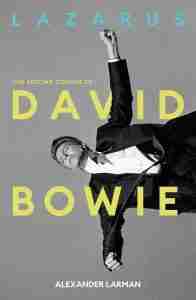
As far as I know, Larman was not involved with The Final Act, but his book and the documentary cover the same ground, which is to say Bowie’s career from Tin Machine on. I liked both, though I liked the book much more. Despite all I already knew about Bowie, I learned quite a bit from the book. It is also exceptionally well written. I felt propelled along from sentence to sentence and very much enjoyed the act of reading the book.
I enjoyed watching The Final Act, too, though oddly it took me longer to get through than the book. I am finding it harder to find the time to watch something straight through, so I watched the first half of The Final Act in one sitting and the second half in another. I mention this in part because both the documentary and the book feature a turning point for Bowie’s fortunes—his Glastonbury appearance in 2000.
The Bowie mythology that has taken hold since his death is that his artistic output declined in quality after Let’s Dance, but at some point turned around and climaxed with Blackstar. Bowie, the Starman, had become a supernova before burning out and becoming, well, a black star.
The problem is—what was the turning point? Larman, who doesn’t hide his opinions, acknowledges albums such as The Buddha of Suburbia, Heathen and especially 1. Outside as strong. But in his telling, it seems like the 2000 concert transformed the way Bowie was perceived from being something of a has-been to something more like the legend we think of him as today. That said, Blackstar becomes the necessary final chapter to elevate Bowie to a higher status.
That’s much the same conclusion as is reached by The Final Act. The point where I paused my watching was a clip from Reeves Gabrels, Bowie’s key collaborator in the 1990s, saying he decided to move on from Bowie when Bowie decided to go back to his more traditional sound. Immediately, the clip of Gabrels switches to Earl Slick before the Glastonbury story unfolds. The documentary is respectful of Gabrels, Tin Machine and Bowie’s work of the 1990s, but this moment has the feel of the point in a Rocky movie when Rocky gets with the program and regains his mojo.
Conspicuously, the documentary leaves a lot out, most notably the play, Lazarus. I’ve read criticisms that it spent too much time with Tin Machine. That said, unless you’re Ken Burns, you can only fit so much in a documentary. The flow worked, I liked the interviews, and particularly liked seeing the reactions of various collaborators and others to seeing Bowie at Glastonbury.
I have a thought that if Glastonbury helped make Bowie once again seem relevant, that his 1990 Sound and Vision tour sent an inadvertent message that he had become a greatest hits type of artist, which is to say that his period of making cutting-edge, innovative new music was behind him. This wasn’t the only factor, but after Sound and Vision Bowie no longer received the benefit of the doubt. The Final Act (as well as the book) references a particularly scathing review of Tin Machine II (1991). The album really isn’t that bad, but by that point the critics, and perhaps many fans, came to expect that Bowie’s next experiment would be a failure.
At one point I asked Larman to speculate how Bowie’s ’90s albums would have been viewed if Let’s Dance jumped right to Black Tie White Noise. I don’t think I was clear at what I was getting at. The premise of the question was based on the idea that had Black Tie, rather than Tonight, been Bowie’s next album, it would have been a bigger hit and everything that came after would not so much have been described as “his best since Scary Monsters” before being quasi-forgotten, but rather as part of the unbroken continuum of solid work that began with Space Oddity in 1969.
I mentioned that Larman is partial to 1. Outside (so am I). I’ve started reading a book that was published in 2015 that also covers Bowie’s late career, but before Blackstar and before Bowie’s death. I just started, so I’m eager to see how the author, Nicholas Greco, assesses the arc of Bowie’s story before his very final act. The book, David Bowie in Darkness, centers around Outside as the key work from this period. Greco will be joining me as a future guest and I look forward to asking whether his conclusions have changed.
Meanwhile, I have included a link to The Final Act if you want to see it, and be sure to come back tomorrow for my interview with Alexander Larman.